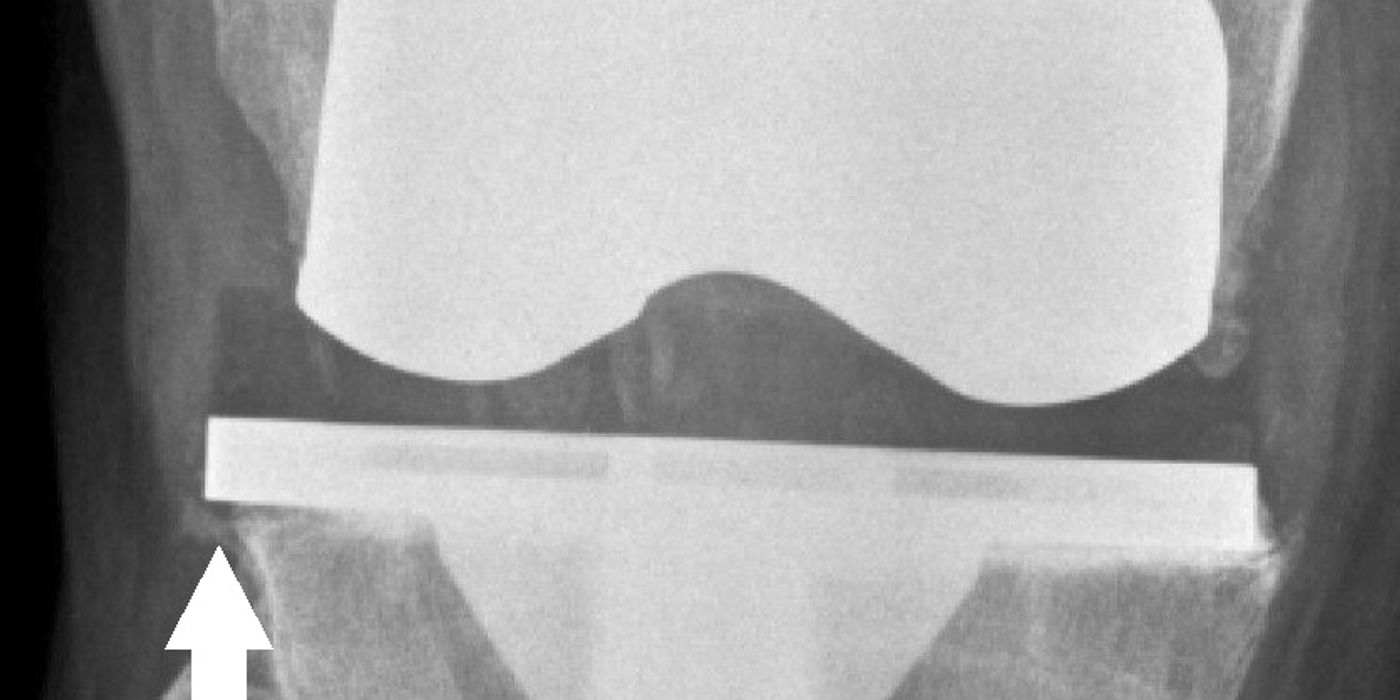
Periprosthetic joint infection (PJI) is infection of a joint replacement and the tissues around it, most commonly after hip or knee arthroplasty. Because the causative organisms live on the implant surface as a biofilm, antibiotics alone cannot cure it: successful treatment almost always combines surgery — debridement with implant retention (DAIR), or single- or two-stage revision — with prolonged targeted antimicrobial therapy. In the UK, the acute presentation is managed according to the British Orthopaedic Association's October 2023 BOAST Acute Management of Peri-prosthetic Joint Infection, whose central rules are immediate sepsis recognition and no antibiotics in the stable patient until deep tissue samples have been taken.
How common is PJI and how is it classified?
PJI complicates roughly 1 in 100 primary hip and knee replacements (published estimates commonly range from about 0.5% to 2%), and the BOA/BASK specialty standard describes it as "one of the most challenging clinical problems in Orthopaedics" — devastating for patients, expensive to treat, and difficult to cure. Classification by timing matters because it predicts biofilm maturity and therefore whether the implant can be retained:
- Early postoperative infection — within roughly 4–6 weeks of the index arthroplasty, usually acquired at surgery. The biofilm is immature, so DAIR may be feasible.
- Acute haematogenous infection — abrupt onset in a previously well-functioning joint, seeded from bacteraemia (skin, dental, urinary or cardiac sources). DAIR may be feasible if symptoms are of short duration.
- Chronic infection — indolent pain, loosening or a sinus, typically presenting months to years after surgery. The mature biofilm means the implant must usually be removed; the Oct 2023 BOAST explicitly excludes "chronic peri-prosthetic joint infection in a stable patient" from its acute pathway.
How is PJI diagnosed?
Suspect PJI in any patient with a painful, warm, swollen or discharging joint replacement, a wound that fails to heal, or unexplained sepsis with a prosthesis in situ. As per the Oct 2023 BOAST, initial investigations should include "Full Blood Count, CRP, renal function, and plain radiographs" — with the important caveat, quoted from the standard, that "inflammatory markers within normal reference ranges do not exclude PJI, especially in the presence of disease or medication mediated immunosuppression."
The diagnostic linchpin is joint aspiration before antibiotics. The BOAST is unambiguous: "A patient who is not septic should not be given antibiotics until appropriate deep tissue samples have been taken." The BOA/BASK specialty standard adds that antibiotics should not be administered for two weeks prior to aspiration or biopsy (except in the systemically unwell, septic patient), that aspiration should be performed aseptically in a clean environment such as theatre or an interventional radiology suite, and that fluid should be sent for culture (including into blood culture bottles where possible) and synovial fluid leucocyte count with neutrophil differential.
For defining infection, UK practice increasingly uses the three-level EBJIS definition (McNally et al., Bone & Joint Journal, 2021), a "traffic light" continuum endorsed by EBJIS, MSIS and ESGIAI:
| Category | Rule | Examples of findings |
|---|---|---|
| Infection unlikely | All findings negative | Synovial leucocytes ≤1,500/μl, PMN ≤65%, cultures negative, histology negative |
| Infection likely | Two positive findings | CRP >10 mg/l; wound healing problems; recent fever/bacteraemia; synovial leucocytes >1,500/μl or PMN >65%; single positive culture |
| Infection confirmed | Any positive confirmatory finding | Sinus tract communicating with the joint; synovial leucocytes >3,000/μl or PMN >80%; positive alpha-defensin; ≥2 cultures with the same organism; ≥5 neutrophils in ≥5 high-power fields on histology |
What is the immediate management of acute PJI?
The Oct 2023 BOAST sets out the acute pathway. Every hospital should have guidance available to primary care and emergency departments on who to contact for a suspected PJI (included in arthroplasty discharge documentation), and a defined pathway for patients presenting to orthopaedics.
The septic patient (as per BOAST standard 3):
- Initiate the "sepsis six" protocol immediately and inform the on-call orthopaedic team.
- Take blood cultures urgently and commence parenteral antibiotics after this according to agreed local protocols.
- Perform emergent surgical drainage by "a suitably experienced surgical team as soon as is safe" — in the acutely unwell patient "this should be within 6 hours unless there are specific reasons that this is not possible."
- When debridement is indicated, take 5 samples for microbiological culture "using separate sterile instruments and a no touch technique for each", plus 2 samples for histological analysis in all chronic infections and whenever the diagnosis is in doubt.
The stable (non-septic) patient: withhold antibiotics until deep samples are taken; document a comprehensive orthopaedic assessment including timing of the index arthroplasty, wound healing problems, prior infections and recent antibiotics; and assess for additional sources of infection "including a cardiovascular assessment for endocarditis". Consultant orthopaedic review should occur "within 48 hours of presentation", with the planned next step documented and onward referral made as appropriate. Definitive management is then informed by sub-specialty guidance.
When is DAIR appropriate, and what should consent cover?
DAIR (debridement, antibiotics and implant retention) is an open, thorough debridement with exchange of modular components (femoral head, liner, tibial insert), retention of well-fixed implants, and prolonged biofilm-active antibiotics. As per the BOA/BASK specialty standard, DAIR "is indicated for acute infections in a well-fixed, well-functioning implant" and "is contra-indicated in the presence of a sinus, loose implant and infections caused by fungal, multi-drug resistant or atypical organisms", with caution advised in immunocompromised or multiply comorbid patients. DAIR "should be performed by an experienced arthroplasty surgeon and modular implants must be exchanged if possible." As good practice, most units also require a short symptom duration (classically under about three weeks, per the widely used Zimmerli algorithm) and an intact soft-tissue envelope. Importantly, the specialty standard states that arthroscopic washout "has no place in the definitive treatment of PJI" — it is at most a temporising, life-saving measure before formal DAIR or revision.
Consent for DAIR (good practice)
- It is a revision-type open procedure, not a "washout": modular components will be exchanged where possible.
- If implants are found to be loose or the infection chronic, the operation may need to convert to, or be followed by, staged revision.
- A prolonged course of intravenous then oral antibiotics will follow; the specialty standard requires the antibiotic plan to be "discussed with the patient, including potential adverse effects and the need for any monitoring."
- DAIR fails in a substantial minority of patients, and failure usually means revision surgery; this possibility should be explicitly acknowledged.
One-stage or two-stage revision?
Where the implant cannot be retained, revision is either single-stage (removal, radical debridement and reimplantation in one sitting) or two-stage (removal with an interval antibiotic-loaded spacer, then delayed reimplantation). As per the BOA/BASK specialty standard, single-stage revision is suitable "when positive pre-operative culture and antibiotic sensitivity has been obtained" or as determined by the MDT taking account of patient factors; two-stage revision is recommended after a failed single stage, for fungal, atypical or multi-drug-resistant organisms, and when pre-operative cultures are negative.
The key trial is INFORM (BMJ, 2022): a pragmatic randomised controlled trial of 140 adults with hip PJI across 12 UK and 3 Swedish centres. There was no difference in WOMAC score at 18 months between single- and two-stage revision (mean difference 0.13, 95% CI −8.20 to 8.46); single-stage patients had better function at 3 months, and intraoperative events were less frequent in the single-stage group (8% vs 27%). Rates of possible ongoing infection at 18 months were similar. INFORM supports single-stage revision as a clinically and cost-effective option in appropriately selected hip PJI, and the choice is now genuinely individualised by the MDT rather than defaulting to two stages.
Why is the MDT central, and what are the outcomes?
The specialty standard requires that all suspected and confirmed PJI is discussed in an infection MDT comprising orthopaedic surgeons, infectious diseases physicians or microbiologists, specialist nurses and an MDT coordinator, with access to pharmacists, plastic surgeons and rehabilitation teams "either locally or through a regional network". Antibiotic choice and duration are determined by the MDT. Tertiary referral is indicated in all complex cases — including every previously failed revision for PJI — and tools such as the Revision Knee Complexity Classification help determine which cases to refer. Every unit managing PJI must submit data to national databases (NJR, BAJIR) to benchmark outcomes. PJI carries substantial morbidity, prolonged treatment and appreciable mortality, and outcomes are best when infection is recognised early, samples are taken before antibiotics, and definitive surgery is delivered by experienced teams within a network.
Key points
- PJI is a biofilm disease: surgery plus prolonged targeted antibiotics, never antibiotics alone.
- Sepsis with a prosthesis: sepsis six, blood cultures, parenteral antibiotics, and emergent drainage — within 6 hours in the acutely unwell patient (Oct 2023 BOAST).
- The stable patient must not receive antibiotics until deep tissue samples are taken; take 5 microbiology samples with separate instruments, plus 2 for histology where indicated.
- Normal inflammatory markers do not exclude PJI; diagnose using the EBJIS three-level definition.
- DAIR is for acute infection in a well-fixed implant with no sinus; exchange modular components; consent for possible failure and staged revision.
- INFORM (BMJ 2022) found no 18-month functional difference between single- and two-stage hip revision — selection is an MDT decision.
- Complex and re-revision cases go to a specialist centre via the regional network; outcomes are audited through NJR/BAJIR.