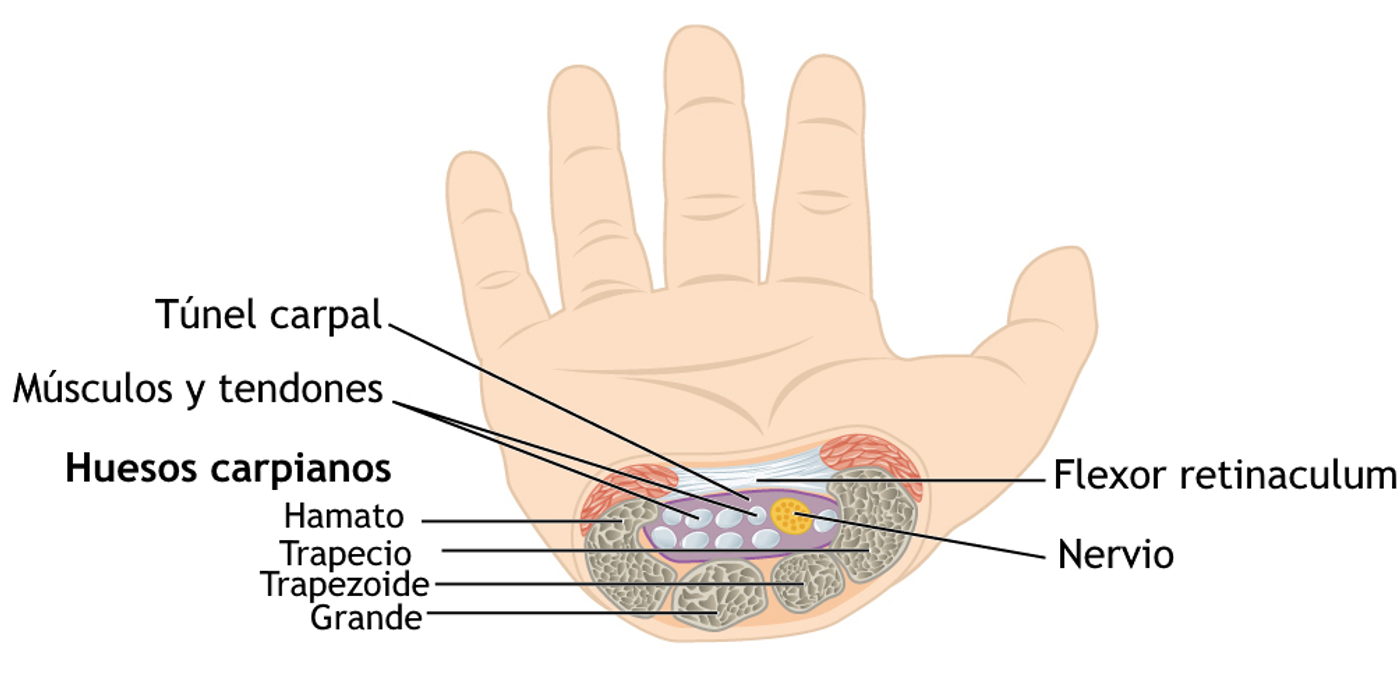
Carpal tunnel syndrome (CTS) is an entrapment neuropathy caused by compression of the median nerve as it passes through the carpal tunnel at the wrist, producing intermittent pain, numbness and paraesthesia in the thumb, index, middle and radial half of the ring finger, classically worse at night. Raised pressure within the tunnel — bounded by the carpal bones and the transverse carpal ligament — causes median nerve ischaemia and impaired conduction. In the UK it is managed along a stepwise ladder: night splinting and/or a single corticosteroid injection for mild-to-moderate disease, with open or endoscopic carpal tunnel release for persistent, progressive or severe symptoms.
How does carpal tunnel syndrome present, and how is it diagnosed?
The diagnosis is primarily clinical. NICE CKS (last revised June 2026) describes intermittent paraesthesia, numbness, burning or pain in the median nerve distribution, often bilateral, waking the patient at night and relieved by shaking the hand (the "flick sign"). Atypical presentations — whole-hand sensory change, or pain radiating to the forearm and shoulder — occur, so examine the entire upper limb (neck, shoulder, elbow, wrist) to exclude cervical radiculopathy, proximal median nerve compression and polyneuropathy.
Signs of prolonged or severe disease are constant sensory deficit, thenar wasting, weak thumb abduction and opposition, and reduced grip, pinch and dexterity. The AAOS clinical practice guideline found thenar wasting strongly rules the diagnosis in, but its absence does not rule it out.
Provocation tests supported by CKS:
- Phalen's test — wrist flexion for 60 seconds reproduces median-distribution pain or paraesthesia.
- Tinel's test — percussion over the median nerve at the volar wrist reproduces paraesthesia; accuracy improves using a tendon hammer.
- Durkan's carpal tunnel compression test — direct thumb pressure over the proximal edge of the transverse carpal ligament provokes or worsens symptoms.
No single test rules the diagnosis in or out; the AAOS guideline advises against using Phalen's or Tinel's tests in isolation, and a combination of positive findings is preferred.
When are nerve conduction studies needed?
CKS is explicit: "referral for nerve conduction studies is not usually needed if there are typical symptoms of CTS." Nerve conduction studies (NCS) are useful to confirm impaired median conduction where the diagnosis is uncertain, to quantify severity, to provide a pre-operative baseline, and to exclude mimics such as polyneuropathy or radiculopathy. Two caveats matter at interview: NCS have only moderate sensitivity and specificity with a low positive predictive value (Atroshi 2003, cited by CKS), and patients with normal studies may still benefit from surgery. In practice many UK units require NCS before listing for release, or for atypical, recurrent or medicolegally sensitive cases — this is local-pathway good practice rather than a national mandate.
What is the initial (non-operative) management?
The NICE CKS management ladder, built on the 2017 RCS England/BSSH/BOA commissioning guide, runs as follows for primary care:
- Information and lifestyle advice — signpost the BSSH and RCS England patient leaflets; advise avoiding repetitive wrist movements, taking breaks from precipitating tasks, and a workplace assessment where there are occupational risk factors (e.g. hand-transmitted vibration).
- Optimise underlying conditions where possible (e.g. hypothyroidism, diabetes, inflammatory arthritis; pregnancy-related CTS often settles after delivery — good practice point).
- Mild or moderate symptoms: a 6-week trial of conservative treatment, choosing from a neutral-position night splint, a single corticosteroid injection into the carpal tunnel, or hand exercises and median nerve mobilisation, then review.
- Refer to a specialist (MSK service, hand or orthopaedic surgeon, rheumatologist or neurologist) if the diagnosis is unclear, symptoms persist despite conservative treatment, there are progressive symptoms or features of severe disease affecting function, or symptoms recur or persist after previous carpal tunnel surgery.
The commissioning guide adds a point candidates should quote: failure of one conservative method suggests others will also fail, so it advises "a maximum trial of two conservative methods to avoid inappropriate delay to surgery" — prolonged untreated symptoms are associated with worse surgical outcomes, and timely surgery prevents avoidable, irreversible motor and sensory deficit.
What is the evidence for corticosteroid injection?
The evidence base is strong for short-term benefit:
- The 2023 Cochrane review (Ashworth et al., injection versus placebo) concluded local corticosteroid injection is effective for mild and moderate CTS, with benefit lasting up to six months and possibly a reduced need for surgery up to 12 months; a dose–response effect appears beyond three months, and serious complications were rare.
- The INSTINCTS trial (Chesterton et al., Lancet 2018) randomised 234 adults with mild-to-moderate CTS to a single 20 mg methylprednisolone injection or six weeks of night splinting: injection was superior at six weeks (adjusted mean difference in Boston Carpal Tunnel Questionnaire score −0.32, effect size 0.41), but outcomes were similar by six months. NICE CKS cites this trial in support of both options.
- Benefit is less durable in severe disease: in a cohort of 273 patients (Visser 2012, cited by CKS), median time to treatment failure was 15 months for mild but only 4.5 months for severe symptoms.
- Against surgery, the 2024 Cochrane review (injection versus surgery) found the comparative evidence up to 12 months too uncertain for reliable conclusions, while the AAOS guideline found strong evidence that surgery gives greater benefit than splinting, NSAIDs or a single injection at 6 and 12 months.
A reasonable synthesis for interview: injection is a legitimate first-line option and a useful diagnostic-prognostic signal, but it is not a substitute for decompression in severe or refractory disease.
How is carpal tunnel release performed — open or endoscopic?
Carpal tunnel decompression divides the transverse carpal ligament, usually as a day case under local anaesthetic (increasingly wide-awake, no-tourniquet technique — good practice, not guideline). CKS, citing the RCS commissioning guide, states open and endoscopic techniques "have similar outcomes in studies." The 2014 Cochrane review (Vasiliadis et al.) compared them directly:
| Outcome | Open release (OCTR) | Endoscopic release (ECTR) |
|---|---|---|
| Symptom relief and function | About as effective as each other (low-quality evidence) | |
| Grip strength | — | Possibly a functionally significant benefit |
| Return to work | — | Faster, by eight days on average |
| Minor complications | More (e.g. wound problems, scar tenderness) | Fewer |
| Major complications (including nerve injury) | No difference demonstrated | |
Open release remains the standard in most UK units; endoscopic release requires specific equipment and training, and the choice is legitimately surgeon- and service-dependent given equivalent headline outcomes.
What are the complications, and does it recur?
Recognised risks of decompression include a sensitive scar, pillar pain, neurovascular injury (median nerve or its palmar cutaneous/recurrent motor branches), infection, incomplete release and complex regional pain syndrome. RCS England cites recurrence rates after carpal tunnel decompression between 0.3% and 12%. Distinguish persistent symptoms (incomplete release, wrong diagnosis, or advanced axonal loss that cannot recover) from true recurrence after an initial good result; both warrant specialist referral under CKS, typically with repeat NCS before any revision surgery (good practice). In severe disease with thenar wasting, decompression halts progression but sensory and motor recovery may be incomplete, so patients should be counselled accordingly. Finally, acute carpal tunnel syndrome — an evolving median nerve deficit after trauma such as a distal radial fracture or in a bleeding diathesis — is a surgical emergency requiring urgent decompression, not the elective pathway (good practice).
Key points
- CTS is the commonest entrapment neuropathy; diagnosis is clinical, and NCS are "not usually needed if there are typical symptoms" (NICE CKS, June 2026).
- Mild-to-moderate disease: 6-week trial of a neutral night splint, a single corticosteroid injection, or nerve-gliding exercises; maximum of two conservative methods before referral (RCS/BSSH/BOA 2017).
- Injection beats splinting at 6 weeks but is equivalent by 6 months (INSTINCTS, Lancet 2018); benefit lasts up to 6 months (Cochrane 2023) and is shortest in severe disease.
- Refer for surgery when the diagnosis is unclear, conservative treatment fails, disease is progressive or severe, or symptoms recur after previous release.
- Open and endoscopic release have equivalent symptom outcomes; endoscopic offers faster return to work (~8 days) but no difference in major complications (Cochrane 2014).
- Recurrence after decompression is 0.3–12% (RCS England); severe disease may recover incompletely, so operate before irreversible deficit develops.