Osteoarthritis of the hip and knee is a chronic, whole-joint disorder in which articular cartilage loss, subchondral bone remodelling and synovial inflammation cause activity-related pain, stiffness and loss of function. It is the commonest joint disease in the UK and the leading indication for hip and knee replacement, of which the National Joint Registry (NJR) has recorded over 4.5 million procedures since 2003. Management follows the NICE NG226 ladder — therapeutic exercise and weight management first, targeted pharmacology second, and referral for joint replacement when symptoms substantially impact quality of life despite non-surgical care.
How does osteoarthritis of the hip and knee present, and how is it diagnosed?
Patients describe activity-related joint pain, short-lived morning stiffness, reduced walking distance and difficulty with stairs, footwear or getting out of chairs. Hip osteoarthritis classically causes groin pain radiating to the knee with restricted internal rotation; knee osteoarthritis causes pain localised to the affected compartment, crepitus, effusion and, later, fixed flexion or varus/valgus deformity. Night and rest pain mark advanced disease.
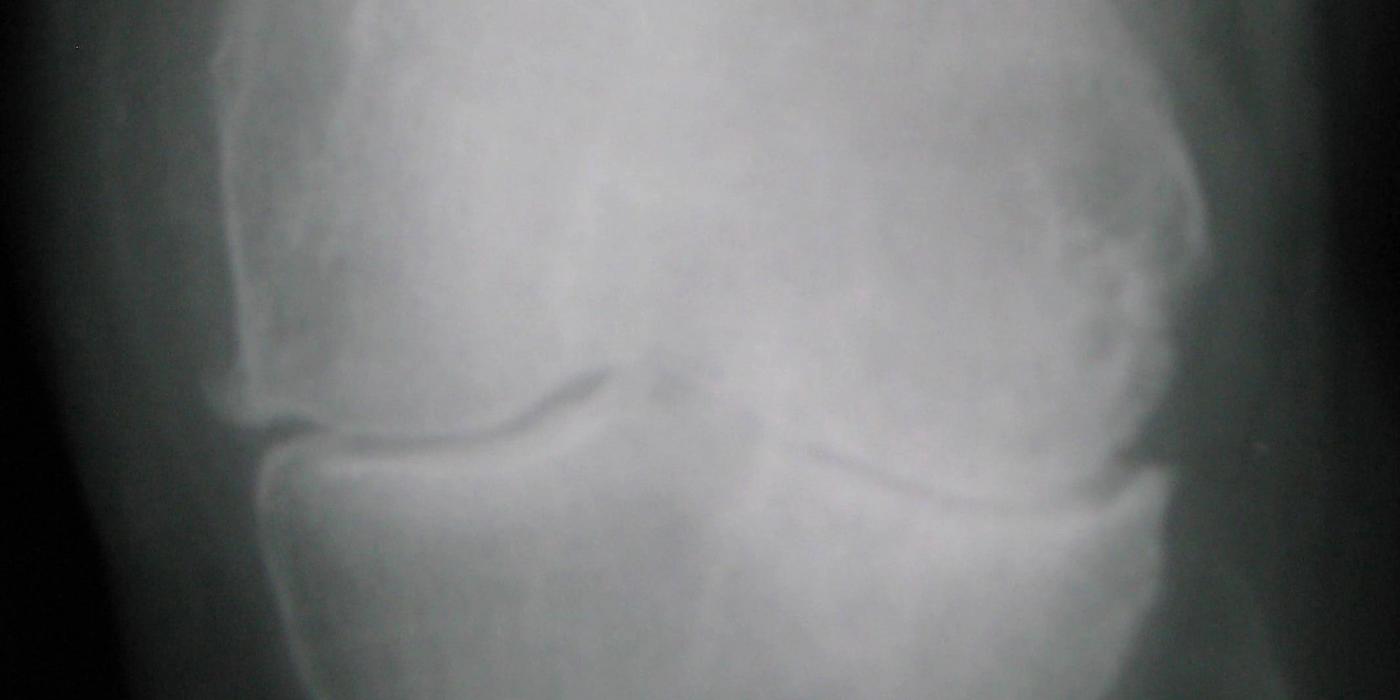
NICE NG226 (2022) makes the diagnosis clinical. Diagnose osteoarthritis without imaging in people who are 45 or over, have activity-related joint pain, and have either no morning joint-related stiffness or morning stiffness lasting no longer than 30 minutes. Do not routinely image unless there are atypical features (rest or night pain, rapid deterioration, hot swollen joint, history of trauma) suggesting an alternative or additional diagnosis such as inflammatory arthropathy, septic arthritis, malignancy or avascular necrosis. When surgery is being considered, weight-bearing radiographs are standard practice: look for the classical tetrad of joint-space narrowing, osteophytes, subchondral sclerosis and cysts, commonly graded by the Kellgren–Lawrence system. Radiographic severity correlates poorly with symptoms, which is precisely why NG226 anchors decisions to clinical assessment rather than imaging.
What is the NICE NG226 management ladder?
NG226 replaced CG177 in October 2022 and stripped the ladder back to interventions with proven benefit. Every patient, at every stage, should be offered the core treatments; drugs are adjuncts to support activity, not a destination.
Core treatments (offer to all)
- Therapeutic exercise tailored to the patient — local muscle strengthening and general aerobic fitness — ideally supervised and combined with education. Advise that pain may transiently increase before improving with sustained exercise.
- Weight management: for anyone living with overweight or obesity, advise that weight loss will improve quality of life, physical function and pain; losing 10% of body weight is likely to be better than 5%.
- Information and support for self-management, with walking sticks considered for lower-limb disease.
Adjuncts — what NG226 recommends and rejects
| Recommended (offer/consider) | Not recommended (do not offer) |
|---|---|
| Topical NSAID — first-line drug for knee osteoarthritis; consider for other joints | Paracetamol or weak opioids routinely (only infrequent, short-term use when everything else is contraindicated, not tolerated or ineffective) |
| Oral NSAID if topical treatment is ineffective — lowest effective dose, shortest time, with a proton pump inhibitor, reviewing gastrointestinal, renal and cardiovascular risk | Strong opioids; glucosamine |
| Intra-articular corticosteroid when other pharmacological options fail or to support therapeutic exercise — explain relief is short term (2 to 10 weeks) | Intra-articular hyaluronan |
| Manual therapy only for hip or knee disease and only alongside exercise; insoles/braces only where instability or abnormal biomechanical loading coexists with pain and exercise alone is insufficient | Acupuncture or dry needling; electrotherapy (TENS, ultrasound, interferential, laser, pulsed short-wave) |
Follow-up should usually be patient-initiated, and imaging should not routinely be used to guide non-surgical management.
When should a patient be referred for joint replacement?
NG226 gives three linked instructions worth quoting in an interview:
- Refer: "Consider referring people with hip, knee or shoulder osteoarthritis for joint replacement if their joint symptoms are substantially impacting their quality of life and non-surgical management is ineffective or unsuitable." Refer before there is prolonged and established functional limitation and severe pain.
- How to decide: "Use clinical assessment when deciding to refer someone for joint replacement, instead of systems that numerically score severity of disease" — so Oxford Hip/Knee Score thresholds must not act as referral gatekeepers.
- Who not to exclude: "Do not exclude people with osteoarthritis from referral for joint replacement because of age, sex or gender, smoking, comorbidities, or overweight or obesity" — a direct rebuke to BMI-based rationing policies. Optimisation (weight, smoking, diabetes, anaemia, dental and skin health) remains good practice to reduce perioperative risk, but it runs alongside referral rather than blocking it.
Shared decision-making should cover expected benefits (reliable pain relief and functional gain in the great majority), recovery, and the realistic risks below. Total hip replacement and total knee replacement are the definitive operations; unicompartmental knee replacement is an option for isolated medial compartment disease in appropriately selected patients, trading a higher revision rate for faster recovery and better range of movement.
Which implant? NJR, ODEP and GIRFT context
The NJR — the world's largest arthroplasty registry — provides the outcomes framework UK surgeons are expected to work within. Its 22nd Annual Report (2025) shows revision rates falling year on year, evidence that implant selection and surgical practice have improved. Surgeon- and unit-level data are published, and every ST3 candidate should know their unit contributes to it via consultant-level reporting.
The Orthopaedic Data Evaluation Panel (ODEP) rates implants by years of evidence (pre-entry, 3, 5, 7, 10, 13, 15) and strength of that evidence (A* strongest, then A, then B), benchmarked against maximum revision thresholds. A 15A* cup, for example, has registry-quality evidence of low revision at 15 years. Getting It Right First Time (GIRFT) asks units to justify using any implant that is more expensive yet lacks a 10A ODEP rating, and to increase cemented or hybrid fixation in older patients — in patients aged 70 and over, cemented/hybrid hip fixation has risen to around 76% against GIRFT's 80% ambition. Good practice at interview: choose a well-proven construct (for instance a cemented, ODEP 10A-or-better stem in the elderly) and be able to defend the choice with registry data rather than novelty.
What are the current debates: day-case and robotic arthroplasty?
Day-case (ambulatory) arthroplasty. The March 2023 GIRFT/BOA guide to perioperative ambulatory care sets a default 0- or 1-night stay for primary hip and knee replacement. Its key principle is that all patients are placed on the ambulatory pathway by default rather than pre-selected — "do not exclude patients from this pathway based on variables such as age, frailty, specific co-morbidity; instead optimise, enable, and assess the outcome." Enablers include opioid-sparing short-duration spinal anaesthesia, protocolised enhanced recovery, criteria-based discharge competences (standing within an hour of spinal offset, safe walking and stairs), and therapy cover extended to 20:00. Exemplar NHS units report day-case rates above 50% with mean lengths of stay of 1.0–1.8 days on unselected patients.
Robotic-assisted arthroplasty. Robotic platforms improve the precision of component positioning, but whether that translates into better patient-reported outcomes or cost-effectiveness in the NHS is unproven. The NIHR-funded RACER-Knee and RACER-Hip multicentre randomised trials (protocols published in BMJ Open, 2023) are comparing robotic-arm-assisted against conventional total knee and hip replacement with the Forgotten Joint Score at 12 months as the primary outcome; definitive results are awaited. The balanced interview answer: an interesting technology with plausible mechanisms of benefit, currently justified within trials, registries and Beyond Compliance-style surveillance rather than by claims of superiority.
What are the outcomes and complications?
Joint replacement for end-stage osteoarthritis is among the most clinically effective and cost-effective operations in surgery. Landmark meta-analyses of registry data (Evans et al., The Lancet, 2019) show that about 58% of total hip replacements and about 82% of total knee replacements last 25 years. Complications to quote when consenting:
- Infection — periprosthetic joint infection in roughly 1%; the acute management of a suspected PJI (urgent aspiration before antibiotics, early referral to a revision network, DAIR within the appropriate window) follows the October 2023 BOAST on acute peri-prosthetic joint infection.
- Hip-specific — dislocation, leg-length discrepancy, sciatic nerve injury, periprosthetic fracture.
- Knee-specific — stiffness/arthrofibrosis, extensor mechanism problems, and a persistent minority with ongoing pain or dissatisfaction despite a well-functioning implant, which should be discussed explicitly at consent.
- Systemic — venous thromboembolism (chemical and mechanical prophylaxis per NICE NG89), medical complications, mortality (low but never zero), and aseptic loosening or wear leading to revision.
Key points
- Diagnose clinically (NG226): age 45+, activity-related pain, morning stiffness ≤30 minutes — no routine imaging.
- Core treatment for everyone is therapeutic exercise plus weight management; topical then oral NSAIDs are the main adjuncts; paracetamol, strong opioids, glucosamine, hyaluronan, acupuncture and electrotherapy are out.
- Refer for arthroplasty when symptoms substantially impact quality of life and non-surgical care has failed — using clinical assessment, not scores, and never excluding by age, BMI, smoking or comorbidity.
- Choose implants with strong registry pedigree: ODEP 10A or better, cemented/hybrid fixation favoured in older patients, benchmarked through the NJR and GIRFT.
- Day-case arthroplasty is a whole-pathway default (GIRFT/BOA 2023), not a patient-selection exercise; robotic arthroplasty awaits RACER trial evidence.
- Know the survivorship numbers: ~58% of hips and ~82% of knees last 25 years; suspected PJI is managed per the Oct 2023 BOAST.