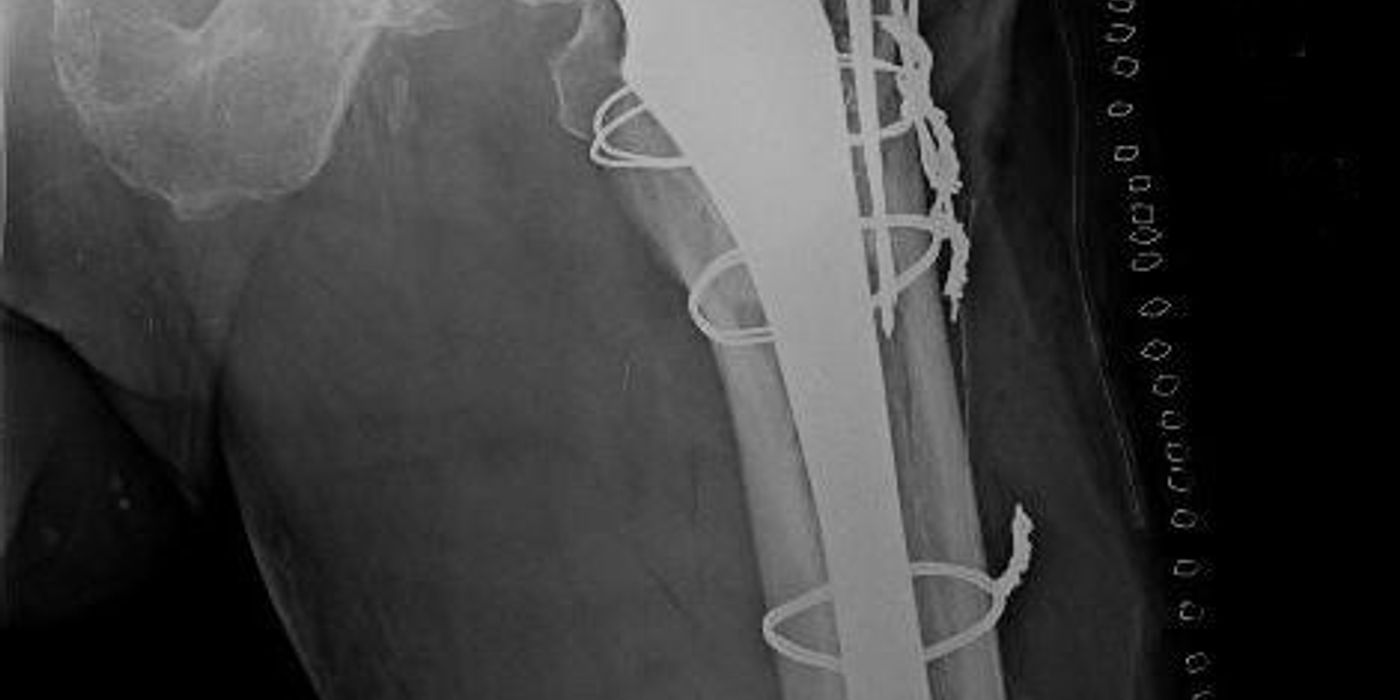
Periprosthetic hip fractures are fractures of the femur (or, less commonly, the acetabulum) around a hip replacement, typically after a low-energy fall in an older patient. Management hinges on one question — is the femoral stem still well fixed? Well-fixed stems (Vancouver B1) are treated with fixation, loose stems (B2/B3) usually with revision arthroplasty, although selected B2 fractures around cemented polished taper stems can be fixed in frail, low-demand patients. These patients should be managed on a hip-fracture-style frailty pathway with orthogeriatric co-management and surgery that permits immediate full weight-bearing.
Why do periprosthetic hip fractures matter?
As the arthroplasty population ages, periprosthetic fracture has become one of the commonest reasons a hip replacement fails. In the National Joint Registry (NJR) 22nd Annual Report (2025), periprosthetic fracture was the third most common indication for first revision of a primary hip replacement, accounting for 8,672 first revisions (around 17% of revision indications). The NJR also notes that revision rates for periprosthetic fracture are substantially higher in the first postoperative year with uncemented stems, observing that early postoperative femoral fracture is a complication predominantly associated with uncemented fixation — a point frequently explored in interviews when discussing implant choice in older patients.
How do periprosthetic hip fractures present and how are they assessed?
The typical patient is elderly and frail, presenting after a low-energy fall with hip or thigh pain, inability to weight-bear and often a shortened, externally rotated limb. Two features of the history deserve specific attention: the identity and age of the implant (obtain the operation note and previous radiographs where possible), and whether there was pain before the fall — pre-existing start-up thigh pain suggests loosening, and rest pain or systemic symptoms raise the possibility of periprosthetic joint infection (PJI) as the underlying cause.
Imaging must include orthogonal radiographs of the full length of the femur, capturing the entire prosthesis and cement mantle, compared against previous films for subsidence or progressive lucent lines. CT can help where stem fixation or fracture extent is unclear. Baseline bloods should include inflammatory markers. If infection is suspected, the BOAST on Acute Management of Peri-Prosthetic Joint Infection (October 2023) applies: "A patient who is not septic should not be given antibiotics until appropriate deep tissue samples have been taken." Where surgery proceeds and infection is possible, five deep tissue samples should be taken with separate sterile instruments.
How are periprosthetic hip fractures classified?
The Vancouver classification (Duncan and Masri, 1995) remains the working language for fractures around a hip stem, and was generalised by Duncan and Haddad in 2014 into the Unified Classification System (UCS), which applies the same logic — site, implant fixation and bone stock — to any periprosthetic fracture. Around the hip, the UCS designations (prefix IV for the hip joint) map directly onto Vancouver types.
| Vancouver / UCS type | Definition | Usual management |
|---|---|---|
| A (AG / AL) | Trochanteric fracture — greater (AG) or lesser (AL) trochanter | Usually non-operative; fix significantly displaced AG fragments affecting abductor function |
| B1 | Fracture around or just below the stem; stem well fixed | Open reduction and internal fixation |
| B2 | Fracture around the stem; stem loose, good bone stock | Revision arthroplasty (or fixation in selected cases — see below) |
| B3 | Fracture around the stem; stem loose with poor bone stock | Revision with distal fixation or proximal femoral replacement |
| C | Fracture well distal to the stem tip | Fixation, treating the fracture independently but bypassing the stem to avoid a stress riser |
What does good initial management look like?
These are frailty fractures and should be treated to the same standard as hip fractures. The BOAST on the Care of the Older or Frail Orthopaedic Trauma Patient (2019) applies to all fragility fractures and explicitly states that "all patients with complex peri-articular or peri-prosthetic fractures should be discussed with specialist fracture surgeons." Its central operative standard is that "All surgery in the frail patient should be performed to allow full weight-bearing for activities required for daily living and within 36 hours of admission, in line with current hip fracture care." Patients should also be "managed in a frailty pathway which includes Comprehensive Geriatric Assessment (CGA) commencing within 72 hours of injury."
In practice this means early analgesia (fascia iliaca block where appropriate), delirium screening and prevention, medication and anticoagulation review, pressure-area care, and same-day senior surgical planning so that implants, cables and revision equipment — and a surgeon with revision arthroplasty skills where the stem may be loose — are available for a single definitive operation. Where the local team lacks revision expertise, early transfer or a visiting-surgeon arrangement is preferable to a delayed or inadequate procedure (good practice; the 36-hour target should not drive the wrong operation).
How do you decide between fixation and revision?
The pivotal decision is B1 versus B2: is the stem fixed or loose? Radiographic clues to a loose stem include stem subsidence, a fracture line propagating through the cement mantle, disruption of the stem–cement or cement–bone interface, and pre-existing progressive lucencies on comparison films. The cement mantle deserves specific scrutiny: a fractured mantle with loss of the stem–cement interface effectively defines a B2 injury, whereas a polished taper-slip stem that has subsided slightly within an otherwise intact mantle may still have a reconstructible cement bed. B1 is notoriously over-diagnosed on plain films; a "B1" that fails fixation is often an unrecognised B2, so many surgeons formally test stem stability intra-operatively before committing to fixation alone (good practice).
Definitive management by type:
- B1: internal fixation, typically a long locking plate with cables or cerclage proximally, spanning the whole femur to avoid creating a stress riser (good practice).
- B2: traditionally revision — either an uncemented tapered fluted distally-fixing stem bypassing the fracture, or cement-in-cement revision where a polished stem can be recemented into an intact mantle. However, the dichotomy has softened: Slullitel et al (Bone & Joint Journal, 2021) showed that low-demand, elderly patients with B2 fractures around well-cemented polished stems with an intact bone–cement interface can be safely treated with internal fixation, with 90% implant survival at 24 months, comparable to B2 fractures treated with revision (85.8%). Anatomical reduction restores the "tube" around the cement, allowing the taper-slip stem to re-engage. This is now a defensible, evidence-based option in the frail patient, and a strong interview discussion point.
- B3: revision addressing both the loose stem and deficient bone — a distally-fixing revision stem with strut allograft, or proximal femoral replacement in the very frail where immediate full weight-bearing is the priority.
- C: fixation of the distal fracture on its own merits, with the construct overlapping the stem tip.
What are the complications and outcomes?
Reported outcomes mirror the native hip fracture population, with substantial one-year mortality, prolonged rehabilitation and loss of independence; the frailty pathway, early surgery and unrestricted weight-bearing are the main modifiable factors. Surgical complications include infection (managed along BOAST PJI lines), dislocation after revision, non-union or fixation failure (particularly of misclassified B1 injuries), re-fracture at stress risers, and further revision. NJR data show revision for periprosthetic fracture clusters early — highest in the first year, declining, then rising again from around five years — reflecting both early uncemented fracture and late loosening-related fragility of the implant–bone composite.
Key points
- Periprosthetic fracture is the third most common indication for first revision of a hip replacement in the NJR (around 17%); early postoperative femoral fracture is predominantly associated with uncemented stems.
- The Vancouver/UCS classification drives treatment: the decisive question is stem fixation, and B1 is commonly over-called — test stem stability intra-operatively.
- Fix well-fixed stems (B1, C); revise loose stems (B2/B3) — but selected B2 fractures around cemented polished taper stems with an intact cement mantle can be fixed in frail, low-demand patients with comparable implant survival.
- Treat as a frailty fracture under the BOAST standard: surgery within 36 hours where possible, constructed to allow full weight-bearing, with CGA within 72 hours and specialist fracture-surgeon discussion.
- Exclude infection as the cause of a loose stem; in the non-septic patient, do not give antibiotics until deep tissue samples have been taken.