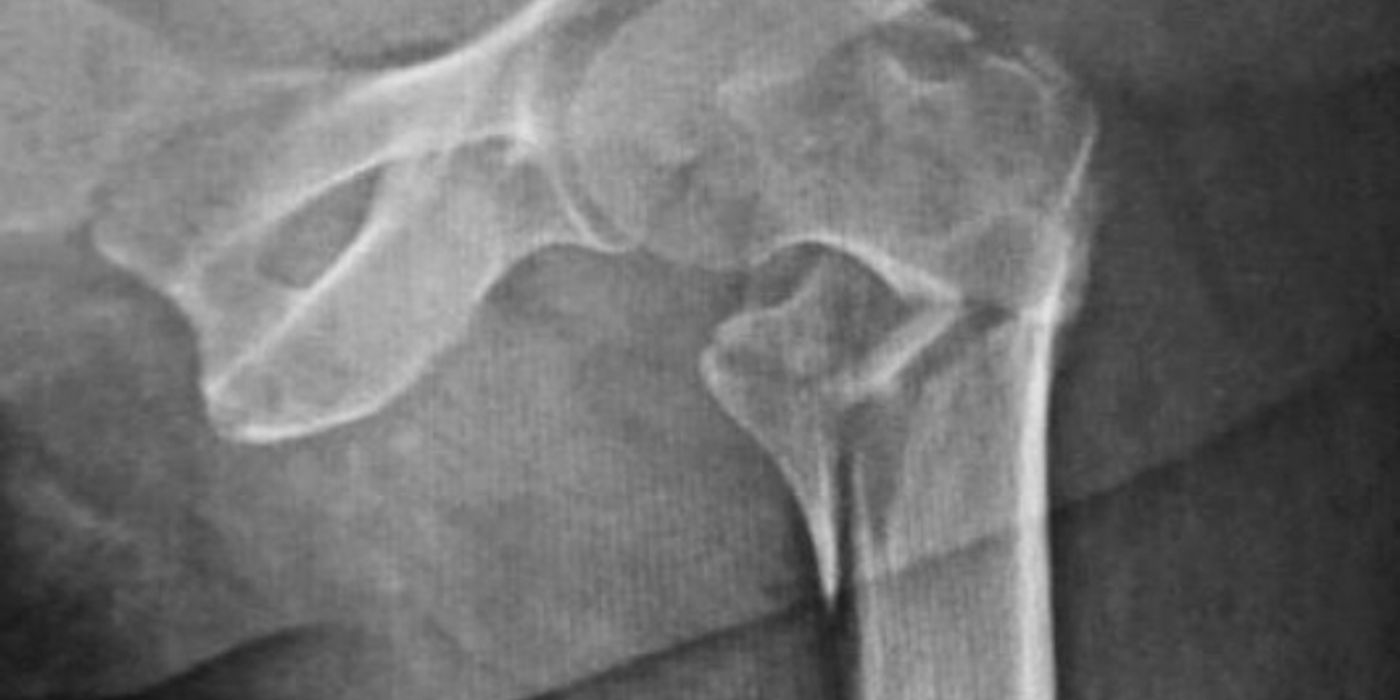
A hip fracture (fractured neck of femur) is a break of the proximal femur between the femoral head and about 5 cm below the lesser trochanter, usually a fragility fracture in an older person after a fall from standing height. It is the commonest serious injury of older people in the UK — over 70,000 cases a year in England, Wales and Northern Ireland — and is managed as a medical–surgical emergency: prompt surgery (target within 36 hours) that allows immediate full weight-bearing, delivered jointly by orthopaedic surgeons and orthogeriatricians under NICE guideline CG124 and the BOA Standard (BOAST) on the care of the older or frail orthopaedic trauma patient.
How are hip fractures classified?
The key division is anatomical, because it determines the blood supply to the femoral head and therefore the operation.
- Intracapsular — through the femoral neck proximal to the capsular attachment. Displacement disrupts the retinacular vessels arising from the medial circumflex femoral artery, risking avascular necrosis (AVN) and non-union. The Garden classification (I–IV) is commonly reduced in practice to undisplaced (Garden I–II) versus displaced (Garden III–IV).
- Extracapsular — trochanteric (between the capsule and the lesser trochanter, AO 31-A1/A2), reverse oblique (31-A3) or subtrochanteric (within 5 cm below the lesser trochanter). The head blood supply is preserved, so these are fixed, not replaced.
| Fracture pattern | Typical definitive treatment (NICE CG124) |
|---|---|
| Undisplaced intracapsular | Internal fixation (or arthroplasty in the frail/arthritic hip) |
| Displaced intracapsular | Arthroplasty — cemented hemiarthroplasty, or total hip replacement in selected patients |
| Trochanteric A1/A2 (above and including the lesser trochanter) | Extramedullary sliding hip screw (DHS) |
| Reverse oblique (A3) | Intramedullary nail |
| Subtrochanteric | Intramedullary nail |
How do hip fractures present and how are they diagnosed?
The classic picture is an older patient who cannot weight-bear after a fall, with a shortened, externally rotated leg and pain on rotation; undisplaced fractures may allow walking. Assess and document why the patient fell — syncope, sepsis, stroke and silent myocardial infarction are common precipitants — plus cognition (a validated tool such as the 4AT), comorbidity, anticoagulation and pre-injury mobility, all of which drive surgical decision-making.
Diagnosis is by AP pelvis and lateral hip radiographs. If radiographs are normal but clinical suspicion persists, NICE recommends MRI as the investigation of choice for occult fracture, with CT as the alternative when MRI is not available within 24 hours. In younger adults a hip fracture implies high-energy trauma or pathological bone — assess accordingly.
What is the correct initial management?
Initial management follows the frailty BOAST (BOA, 2019: The Care of the Older or Frail Orthopaedic Trauma Patient) and NICE CG124:
- Analgesia — immediate assessment with a patient-appropriate pain tool and multimodal analgesia including "peripheral nerve blockade when appropriate" (in practice a fascia iliaca or femoral nerve block), limiting opioids and avoiding NSAIDs in renal impairment.
- Do not starve the patient — patients "should not be nil by mouth unless immediate surgery is planned", and preoperative fluid intake should be encouraged.
- Optimise, don't delay — correct anaemia, dehydration, electrolytes, anticoagulation (units must have reversal protocols) and treat acute illness in parallel with surgical planning, not as a reason for postponement (good practice: only conditions that genuinely change perioperative risk, such as uncontrolled sepsis or an uncorrected coagulopathy, justify delay).
- Frailty pathway — Comprehensive Geriatric Assessment commencing within 72 hours of injury; delirium screening (e.g. 4AT) with preventative measures; VTE risk assessment and prophylaxis; ceilings of treatment and CPR status discussed and documented at consultant level before any surgery, involving the patient and family.
When should surgery take place — and what is the 36-hour target?
NICE CG124 states: perform surgery "on the day of, or the day after, admission". This is operationalised in England as the 36-hour target (arrival in the emergency department — or diagnosis if an inpatient — to anaesthesia), a Best Practice Tariff criterion audited by the National Hip Fracture Database (NHFD). The frailty BOAST puts both timing and construct choice in one standard: "All surgery in the frail patient should be performed to allow full weight-bearing for activities required for daily living and within 36 hours of admission, in line with current hip fracture care." Restricted weight-bearing is effectively non-weight-bearing in a frail patient, so any fixation or arthroplasty must be stable enough for immediate full weight-bearing. Physiotherapy assessment and mobilisation should follow on the day after surgery, with at least daily mobilisation thereafter.
Hemiarthroplasty or total hip replacement for displaced intracapsular fractures?
Displaced intracapsular fractures in older patients are treated with arthroplasty. Following its 2023 update, NICE CG124 advises: consider total hip replacement rather than hemiarthroplasty for people who were able to walk independently out of doors with no more than the use of a stick, do not have a condition or comorbidity that makes the procedure unsuitable, and are expected to be able to carry out activities of daily living independently beyond 2 years. Everyone else receives a hemiarthroplasty.
The evidence base is worth quoting at interview. The HEALTH trial (NEJM 2019; 1,495 patients aged ≥50 with displaced femoral neck fracture) found no significant difference in secondary hip procedures at 24 months between THR (7.9%) and hemiarthroplasty (8.3%), with more instability/dislocation after THR (4.7% vs 2.4%) — supporting selective rather than universal THR. On fixation of the stem, NICE says use cemented implants with a proven design; WHiTE 5 (NEJM 2022) showed cemented hemiarthroplasty gave better health-related quality of life at 4 months than modern uncemented stems and markedly fewer periprosthetic fractures (0.5% vs 2.1%). NICE also advises considering an anterolateral rather than posterior approach for hemiarthroplasty.
Undisplaced intracapsular fractures are generally treated with internal fixation (screws or a sliding hip screw); the FAITH trial (Lancet 2017) found no overall reoperation advantage for sliding hip screw over cancellous screws, though displaced, basicervical and smoking subgroups may do better with a sliding hip screw. In young adults with intracapsular fractures, urgent anatomical reduction and fixation to preserve the native head is standard practice (good practice rather than a CG124 recommendation).
DHS or intramedullary nail for extracapsular fractures?
NICE CG124 is explicit: use extramedullary implants such as a sliding hip screw in preference to an intramedullary nail for trochanteric fractures above and including the lesser trochanter (AO 31-A1/A2), and use an intramedullary nail for reverse oblique (31-A3) and subtrochanteric fractures. The rationale: in stable trochanteric patterns the DHS achieves equivalent outcomes at lower cost, permitting controlled collapse across an intact lateral wall; in reverse oblique and subtrochanteric patterns the fracture line parallels the screw's sliding axis and the lateral wall is deficient, so a DHS displaces medially and fails — a cephalomedullary nail resists this. Lateral wall integrity should be assessed on the AP radiograph before choosing a DHS (good practice).
What does orthogeriatric co-management involve, and what is the NHFD?
NICE CG124 requires every patient to be managed on a Hip Fracture Programme: orthogeriatric assessment from admission, rapid optimisation for surgery, early identification of rehabilitation goals, and multidisciplinary review — with falls assessment and bone health treatment (only 58% of patients currently leave hospital on bone-strengthening medication per the 2025 NHFD report) before discharge. The National Hip Fracture Database, launched in 2007 and now the world's largest hip fracture audit, underpins this: the frailty BOAST mandates submission to the NHFD (with FLS-DB and TARN), and in England the Best Practice Tariff pays hospitals for meeting audited criteria including the 36-hour target, orthogeriatric assessment, delirium screening, prompt mobilisation, and falls and bone health assessment. This audit-plus-incentive model is credited with driving 30-day mortality down from around 11% at the database's launch to roughly 6.5% pre-pandemic.
What are the complications and prognosis?
- Early: delirium (common — screen with 4AT), VTE, pneumonia, pressure ulcers, acute kidney injury.
- Fixation of intracapsular fractures: AVN and non-union, rising with initial displacement; failure usually salvaged by arthroplasty.
- Arthroplasty: dislocation (higher after THR), periprosthetic fracture (higher with uncemented stems), infection; bone cement implantation syndrome is a recognised intraoperative risk of cementing in the frail.
- DHS/nail: lag screw cut-out (predicted by a long tip–apex distance and poor reduction), medialisation with a DHS used in unstable patterns, nail-related peri-implant fracture.
Around a third of patients die within a year (mostly from comorbidity, not the fracture itself), many do not regain their pre-injury mobility, and a significant minority need a new care-home placement — which is why process targets, early surgery and orthogeriatric co-management matter.
Key points
- Intracapsular fractures threaten the femoral head blood supply and are replaced when displaced; extracapsular fractures are fixed.
- Operate on the day of, or day after, admission (36-hour target); surgery must allow immediate full weight-bearing, per the frailty BOAST.
- Displaced intracapsular: cemented arthroplasty; consider THR for independent outdoor walkers with ≥2 years' expected independence (HEALTH, WHiTE 5).
- Trochanteric A1/A2: sliding hip screw. Reverse oblique and subtrochanteric: intramedullary nail (NICE CG124).
- Orthogeriatric co-management with CGA within 72 hours, falls and bone health assessment, and NHFD submission are standards of care, incentivised by the Best Practice Tariff.