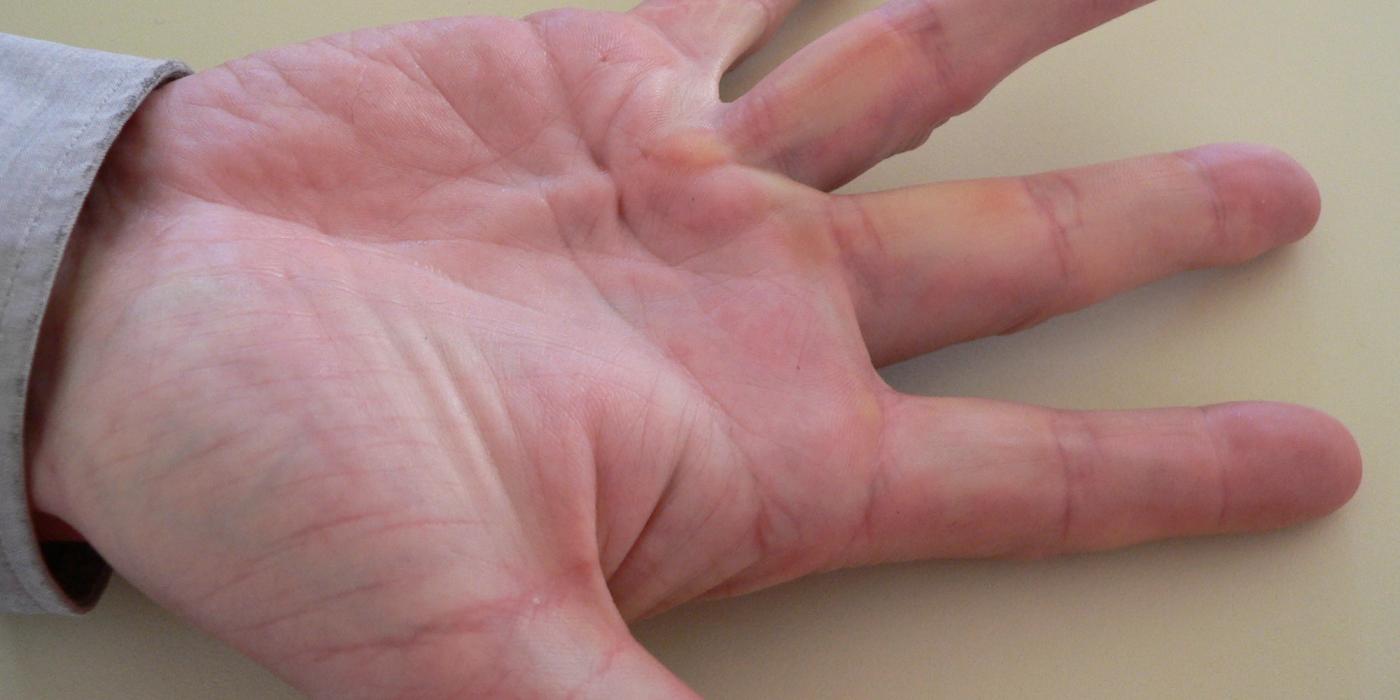
Dupuytren's disease is a benign, progressive fibroproliferative disorder of the palmar fascia in which myofibroblast-rich nodules and collagen cords form beneath the skin of the palm and fingers, and may draw the fingers into fixed flexion (Dupuytren's contracture). The disease itself cannot be cured; treatment is offered when contracture impairs hand function, and in current UK practice the realistic options are percutaneous needle fasciotomy or surgical fasciectomy, because collagenase injection (Xiapex) was withdrawn from the UK market in 2020.
Who gets Dupuytren's disease, and what causes it?
The condition usually appears in middle age or later, is more common in men, and is most prevalent in people of Northern European descent; it frequently runs in families. As the British Society for Surgery of the Hand (BSSH) notes, associations exist with diabetes, smoking and alcohol consumption, though many patients have none of these; manual work is not considered causative, although the disease occasionally follows hand injury or surgery.
Pathologically, this is a fibromatosis: myofibroblasts proliferate within the palmar fascia and deposit disorganised collagen with an increased type III:type I ratio. Luck's three phases — proliferative (cellular nodules), involutional (cells align along tension lines) and residual (relatively acellular cord) — remain a useful framework. Normal fascial bands become diseased cords: the pretendinous cord flexes the metacarpophalangeal joint (MCPJ), central and lateral cords flex the proximal interphalangeal joint (PIPJ), and the spiral cord (pretendinous band, spiral band, lateral digital sheet and Grayson's ligament) classically displaces the digital neurovascular bundle towards the midline and superficially — the key hazard during any release. Tumour necrosis factor has been identified as a therapeutic target: in the phase 2b RIDD trial (Lancet Rheumatology, 2022), intranodular adalimumab softened and shrank early-stage nodules versus placebo, though this is not yet a licensed treatment.
A Dupuytren's diathesis — young age of onset, bilateral disease, strong family history and ectopic disease (Garrod's knuckle pads, plantar fibromatosis/Ledderhose, Peyronie's disease) — predicts aggressive disease and higher recurrence, and should lower the threshold for more radical surgery such as dermofasciectomy.
How does it present, and how should it be assessed?
Patients present with palmar nodules, skin pitting and cords, most often affecting the ring and little fingers, progressing over years to MCPJ and PIPJ flexion contractures. Assessment is clinical; no imaging is required. Good practice is to:
- Document fixed flexion deformity at each joint (MCPJ and PIPJ) with a goniometer, per digit.
- Perform the table-top test (Hueston): inability to place the palm flat on a table indicates functionally significant contracture.
- Record functional limitation (grip, gloves, pockets, face washing), diathesis features and relevant comorbidities.
- Exclude differentials: trigger finger, camptodactyly, post-traumatic scar contracture, palmar ganglion or a soft-tissue tumour.
When is intervention indicated?
Nodules and cords without contracture need no treatment beyond explanation and safety-netting; BSSH advises that surgery is not needed if the fingers can be straightened fully, and states plainly that "published evidence does not support the use of radiotherapy" for early disease. Intervention is considered once contracture is established: BSSH advises that surgery "is likely to be helpful when it has become impossible to put the hand flat on a table".
As good practice (reflected in most UK commissioning policies rather than a single national guideline), referral and intervention are usually reserved for:
- MCPJ contracture of roughly 30° or more, or
- Any significant or progressive PIPJ contracture (PIPJ disease stiffens and corrects less reliably, so many surgeons treat it earlier), or
- Contracture causing material impairment of hand function.
Patients should understand that treatment corrects contracture but does not eradicate the disease, which may recur in the treated digit or appear elsewhere in the hand.
Which procedure: needle fasciotomy, collagenase or fasciectomy?
Percutaneous needle fasciotomy (PNF)
The cord is divided percutaneously with a needle under local anaesthetic, typically as an outpatient procedure. It suits a well-defined palmar cord with predominantly MCPJ contracture, and older or frailer patients prioritising rapid recovery. The trade-off is durability: in the randomised trial by van Rijssen and colleagues (Plastic and Reconstructive Surgery, 2012), 5-year recurrence was 84.9% after PNF versus 20.9% after limited fasciectomy, yet satisfaction was high in both arms and just over half of patients said they would choose PNF again for recurrence. Risks include skin tears, and digital nerve or flexor tendon injury.
Collagenase injection — the UK context
Collagenase Clostridium histolyticum (Xiapex) enzymatically digests the cord, which is ruptured by manipulation days later. NICE recommended it as an option in TA459 (2017), but the European marketing authorisation was withdrawn at the manufacturer's request — the EMA public statement records that the withdrawal took effect on 1 March 2020 and was "for commercial reasons", not because of safety or efficacy concerns — and NICE TA459 was subsequently withdrawn because the product is no longer available in the UK. Two trials frame its legacy: Strömberg's randomised trial (JBJS Am, 2018) found no advantage of collagenase over PNF at two years (76% vs 79% maintained a straight MCPJ), and the UK DISC trial (NEJM, 2024; 672 patients) found collagenase was not non-inferior to limited fasciectomy for patient-reported hand health at one year, with reintervention for recurrence in 14.6% versus 3.4%. In practice, PNF now occupies the minimally invasive niche that collagenase briefly filled.
Limited (regional) fasciectomy
The workhorse operation in the UK: excision of the diseased cord through a Bruner or longitudinal incision closed with Z-plasties, usually as a day case under regional or general anaesthesia. It gives the most durable correction, addresses PIPJ disease directly, and in DISC produced better one-year patient-reported outcomes than collagenase at the cost of more moderate-to-severe complications (5.1% vs 1.8%) and a slower recovery. Night extension splintage and hand therapy are standard aftercare.
Dermofasciectomy and other options
Dermofasciectomy — excision of the cord together with the overlying skin, resurfaced with a full-thickness skin graft — is reserved for recurrent disease or a strong diathesis with skin involvement, as the graft appears to act as a barrier to recurrence. Segmental fasciectomy through small incisions is a lesser alternative in selected patients. Severe fixed PIPJ contracture occasionally requires supplementary procedures or, in end-stage recurrent disease, arthrodesis or rarely amputation.
| Option | Setting | Best suited to | Key trial data (verified) |
|---|---|---|---|
| Needle fasciotomy | Outpatient, local anaesthetic | Palmar cord, MCPJ disease, older/frail patients, rapid recovery | 84.9% recurrence at 5 years vs 20.9% after fasciectomy (van Rijssen 2012); equivalent to collagenase at 2 years (Strömberg 2018) |
| Collagenase | Withdrawn in UK (March 2020) | — | Not non-inferior to fasciectomy at 1 year; reintervention 14.6% vs 3.4% (DISC, NEJM 2024) |
| Limited fasciectomy | Day case, regional/general anaesthetic | Established MCPJ/PIPJ contracture; most durable correction | 20.9% recurrence at 5 years (van Rijssen 2012); moderate–severe complications 5.1% (DISC) |
| Dermofasciectomy + skin graft | Day case/inpatient | Recurrent disease, strong diathesis, skin involvement | Lowest reported recurrence in cohort series; no RCT-level comparison |
What are the complications, and what should patients expect long term?
- Fasciectomy: digital nerve and artery injury, skin necrosis, haematoma, infection, stiffness, cold intolerance and complex regional pain syndrome; moderate or severe complications occurred in 5.1% in the DISC trial. PIPJ contractures often correct incompletely.
- PNF: skin tears are common and usually heal without consequence; nerve or tendon injury is uncommon but recognised.
- Recurrence: definitions vary between studies (van Rijssen used an increase in total passive extension deficit of more than 30°), which explains the wide range of published rates. Broadly, recurrence is fastest and most frequent after PNF, intermediate after collagenase, and least after fasciectomy; younger patients and those with a diathesis recur sooner.
- Prognosis: the disease is lifelong, but BSSH reassures patients that "most patients who require surgery need only one operation during their lifetime".
Key points
- Dupuytren's disease is a myofibroblast-driven palmar fibromatosis; the spiral cord displaces the neurovascular bundle midline and superficial — the key operative hazard.
- Observe disease without contracture; intervene for a positive table-top test, MCPJ contracture of about 30° or more, any significant PIPJ contracture, or functional impairment.
- Collagenase is no longer an option in the UK: the marketing authorisation was withdrawn for commercial reasons, effective 1 March 2020, and NICE TA459 was withdrawn with it.
- PNF offers quick recovery but 5-year recurrence of around 85% versus around 21% after limited fasciectomy; choose it for palmar MCPJ cords and patients prioritising minimal intervention.
- Limited fasciectomy is the UK workhorse for established contracture; dermofasciectomy with skin grafting is reserved for recurrence or aggressive diathesis.
- Counsel every patient that treatment corrects contracture but does not cure the disease.